Keystone Homes
Keystone Homes explores how product design can reshape the student housing experience. The project focused on understanding where traditional student rentals fall short, including inconsistent housing quality, fragmented setup processes, and unclear expectations during move-in. Grounded in user research with students and parents, Keystone was designed as an end-to-end living experience, where space, service, brand, and operations work together to create confidence, clarity, and ease throughout the housing journey.
Where Student Housing Breaks Down
For many students, securing housing is one of the most stressful parts of the academic experience. Traditional student rentals often involve a patchwork of landlords, outdated units, and fragmented responsibilities, leaving students to manage furnishings, utilities, internet setup, and maintenance on their own. These challenges are especially pronounced for out-of-state and international students, who must navigate the process without local context or support.
The breakdown is not limited to physical space. Students frequently encounter unclear timelines, inconsistent quality across units, and uncertainty about what is included or expected before move-in. Parents, who are often involved in decision-making, experience a parallel lack of confidence, particularly around safety, reliability, and accountability. In both cases, trust is eroded by variability and a lack of cohesive experience.
From a product perspective, these issues point to a systemic problem rather than isolated failures. Housing is delivered as a collection of disconnected components rather than a designed experience. Without a clear structure that aligns space, service, and expectations, students are left to absorb unnecessary friction during a time that should feel stable and predictable. Keystone approaches this gap as an opportunity to redesign student housing around clarity, consistency, and confidence.
Research and Insights
Research for Keystone focused on understanding how students and parents experience the housing process end to end, from search and decision-making through move-in and day-to-day living. Conversations with students surfaced consistent frustrations around uncertainty, fragmented responsibilities, and the amount of effort required to make a space livable. Many described housing as something they had to “figure out” rather than an experience that supported them.
Parents emphasized a different but related set of concerns. Reliability, safety, and accountability were top priorities, particularly when students were living far from home. Rather than evaluating individual features, parents were assessing whether a housing option felt trustworthy and well-managed. This reinforced the importance of consistency and clarity across every touchpoint, not just the physical unit.
Across stakeholders, research revealed that the biggest pain points occurred at moments of transition. Searching for housing, signing a lease, and moving in all required students to manage multiple unknowns at once. These insights reframed the problem from improving individual apartments to designing a cohesive system that reduces cognitive load and uncertainty throughout the housing journey.
Together, these findings shaped Keystone’s design priorities. Instead of optimizing for flexibility or customization, the focus shifted toward move-in readiness, predictable quality, and clearly defined expectations. Research did not just validate the idea, it directly informed how the housing experience would be structured and delivered.
Designing the Housing Experience
Keystone approached student housing as a designed experience rather than a collection of individual units. Research insights pointed to the need for a cohesive system that reduces friction at key moments, particularly during move-in and early occupancy. Design decisions therefore focused on aligning space, service, and expectations into a single, predictable experience.
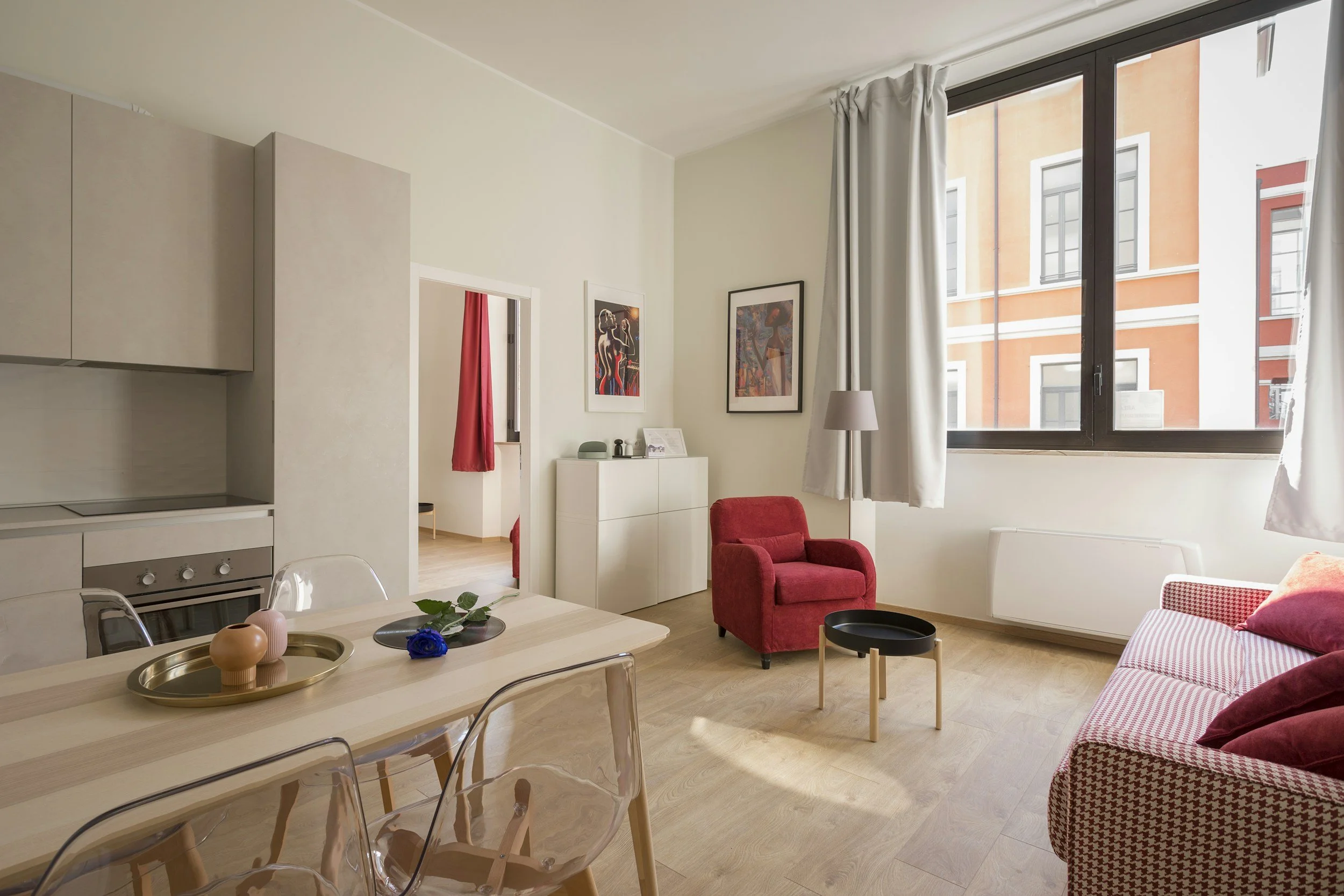
Move-in readiness became a central design principle. Fully furnished units, pre-configured utilities, and clear inclusions were treated as product features rather than operational conveniences. By removing the need for students to coordinate setup independently, the experience shifts from one of uncertainty to one of immediate usability, allowing residents to settle in quickly and confidently.
Consistency across properties was another priority. Instead of allowing variability to accumulate through different landlords or unit conditions, Keystone emphasizes standardized quality and maintenance practices. This consistency supports trust for both students and parents, making it easier to understand what the experience will be before committing to a lease.
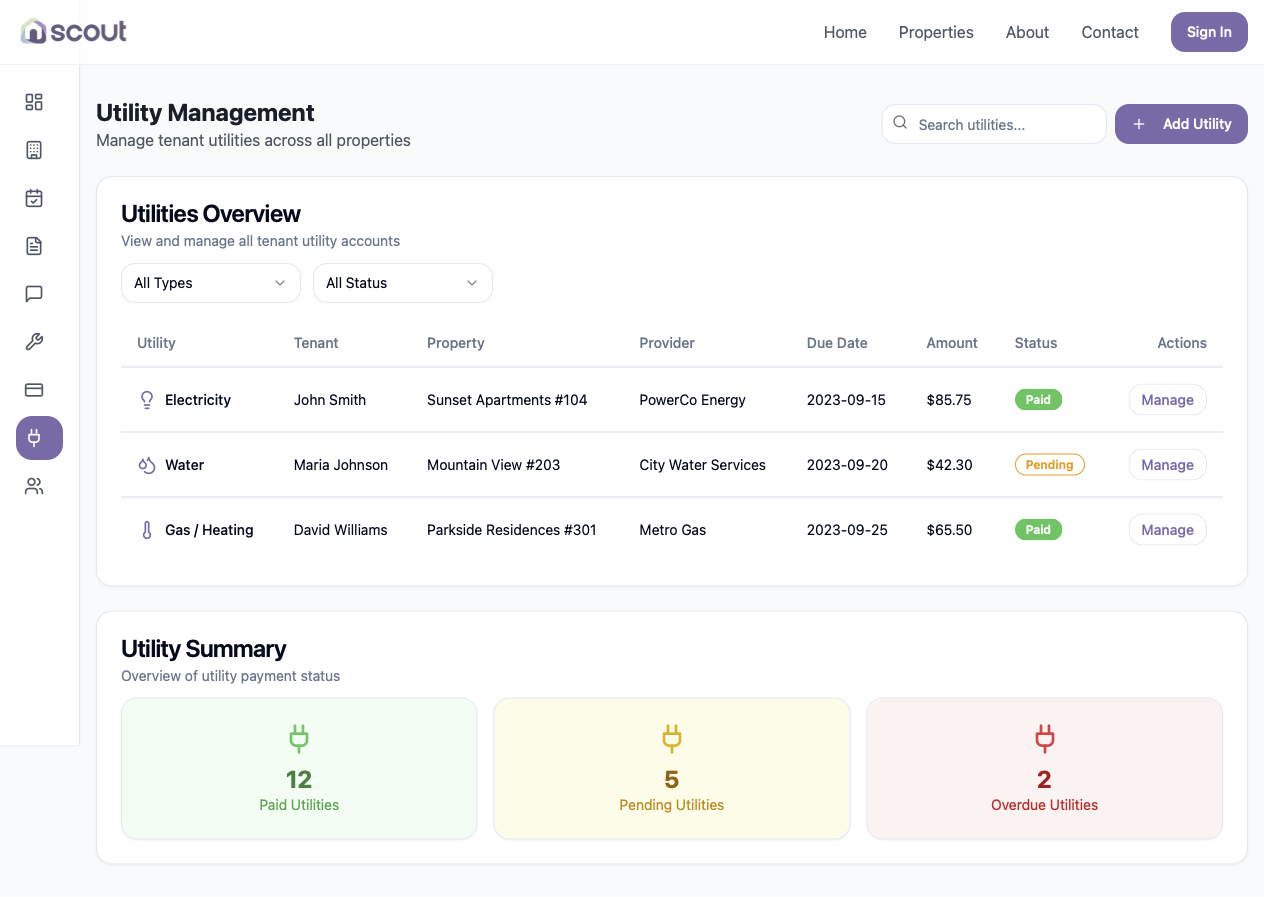
Behind the scenes, Keystone also considered the operational systems required to support this consistency at scale. Admin-facing tools were explored to centralize property information, manage listings, and coordinate maintenance, ensuring that the student-facing experience could remain predictable and well-maintained over time.
Service touchpoints were also considered part of the product. Communication, maintenance response, and ongoing support were designed to feel structured and reliable rather than ad hoc. By treating operations as a user-facing layer, Keystone integrates behind-the-scenes logistics into the overall experience, reinforcing accountability and ease of use.
Together, these decisions frame housing as an integrated system where physical space, service design, and operational clarity work together. The result is an experience designed to reduce cognitive load, support independence, and create confidence throughout the student housing journey.
Brand & Interface Exploration
Brand and interface design were used as tools to support trust and set clear expectations around the Keystone experience. In a housing context where students and parents often feel uncertainty, visual identity and tone play an important role in signaling reliability, care, and professionalism.
The Keystone logo was designed in Figma to reflect stability and simplicity, avoiding visual noise in favor of a restrained, confident identity. Rather than aiming for trend-driven aesthetics, the brand focuses on approachability and consistency, reinforcing Keystone’s positioning as a dependable housing option rather than a short-term rental or informal sublet.
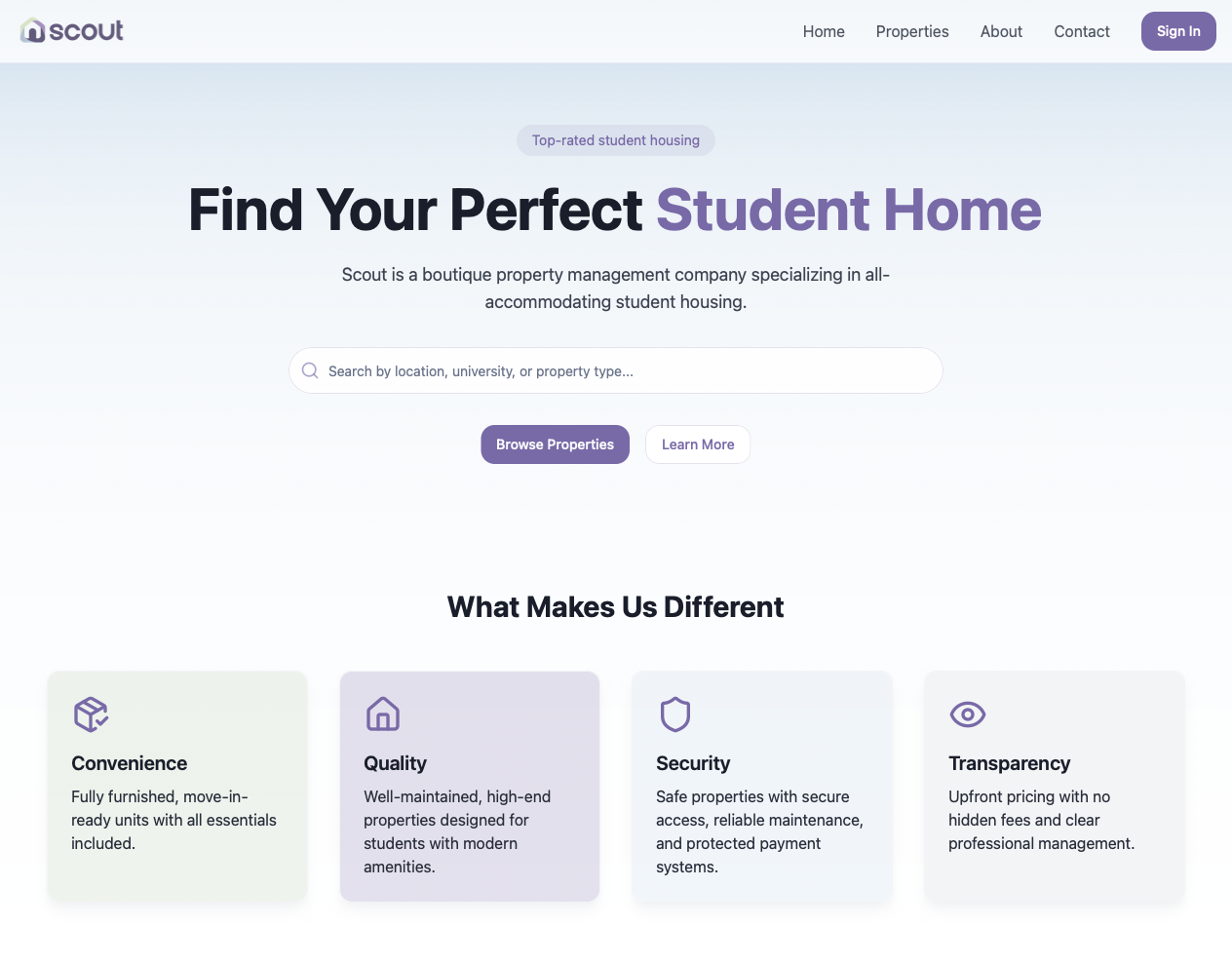
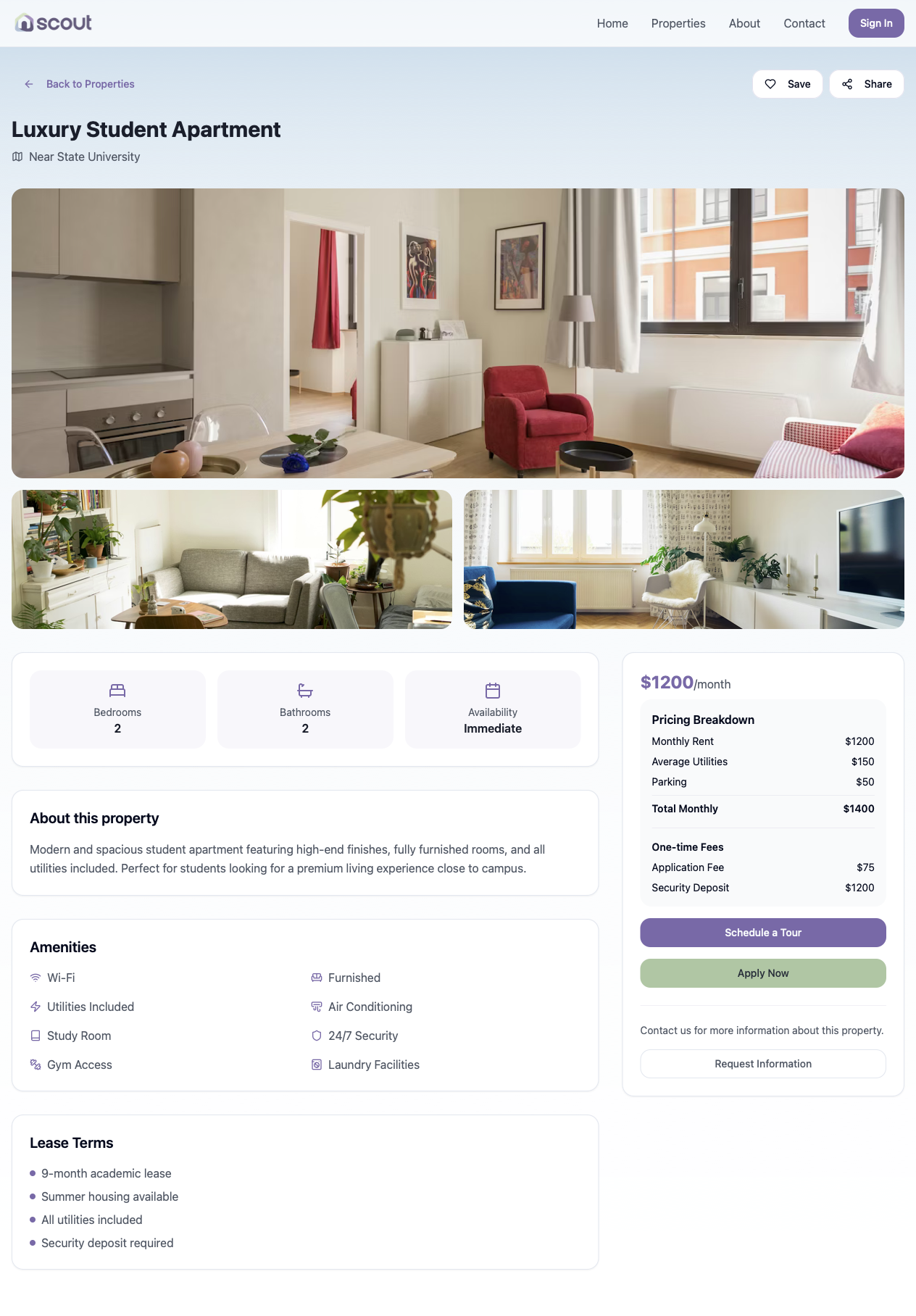
To explore how the housing experience might translate into a digital touchpoint, a prototype website was built using Lovable. The site models how students and parents would encounter the offering during discovery and evaluation, emphasizing clarity around what is included, how the experience works, and what to expect before move-in.
In addition to student-facing pages, early interface concepts included admin-facing views to explore how properties, listings, and maintenance workflows might be managed internally. These screens were not intended as final tools, but as exploratory artifacts to reason through how operational clarity supports a consistent housing experience for residents.
The prototype reflects an early iteration of the venture, which was originally developed under the name Scout. A live version of the prototype is available for exploration here.
Together, these explorations show how brand and interface design can reinforce a larger service system. Rather than standing alone, they support the broader goal of reducing uncertainty and building confidence across the housing journey.
Outcomes & Design Learnings
Designing Keystone reinforced how deeply product design extends beyond interfaces, especially in service- and space-based systems. The project highlighted the importance of treating housing as an end-to-end experience, where physical space, operations, and communication all shape user trust and satisfaction.
Through research and iteration, it became clear that reducing uncertainty mattered more than adding flexibility. Prioritizing move-in readiness, standardized quality, and clear expectations helped reframe housing from a logistical burden into a supportive foundation for student life. These decisions emphasized clarity, consistency, and reliability as core design values.
Keystone also underscored the role of operational systems in delivering a coherent user experience. Exploring admin-side tools revealed how behind-the-scenes structure enables consistency at scale, reinforcing the idea that good product design often depends on invisible infrastructure as much as visible touchpoints.
Overall, this project strengthened my approach to designing complex, multi-stakeholder systems. It reinforced the value of research-driven decision-making and demonstrated how product design can create confidence and ease in everyday experiences that are often taken for granted.