A research-driven redesign of the household measuring cup focused on improving accuracy, accessibility, and usability. Drawing from patents, human-factors standards, and user insights, the design introduces a collapsible silicone cup with top-view markings and an adjustable handle, modeled in Blender to visualize form and function.
Adjustable MEASURING CUP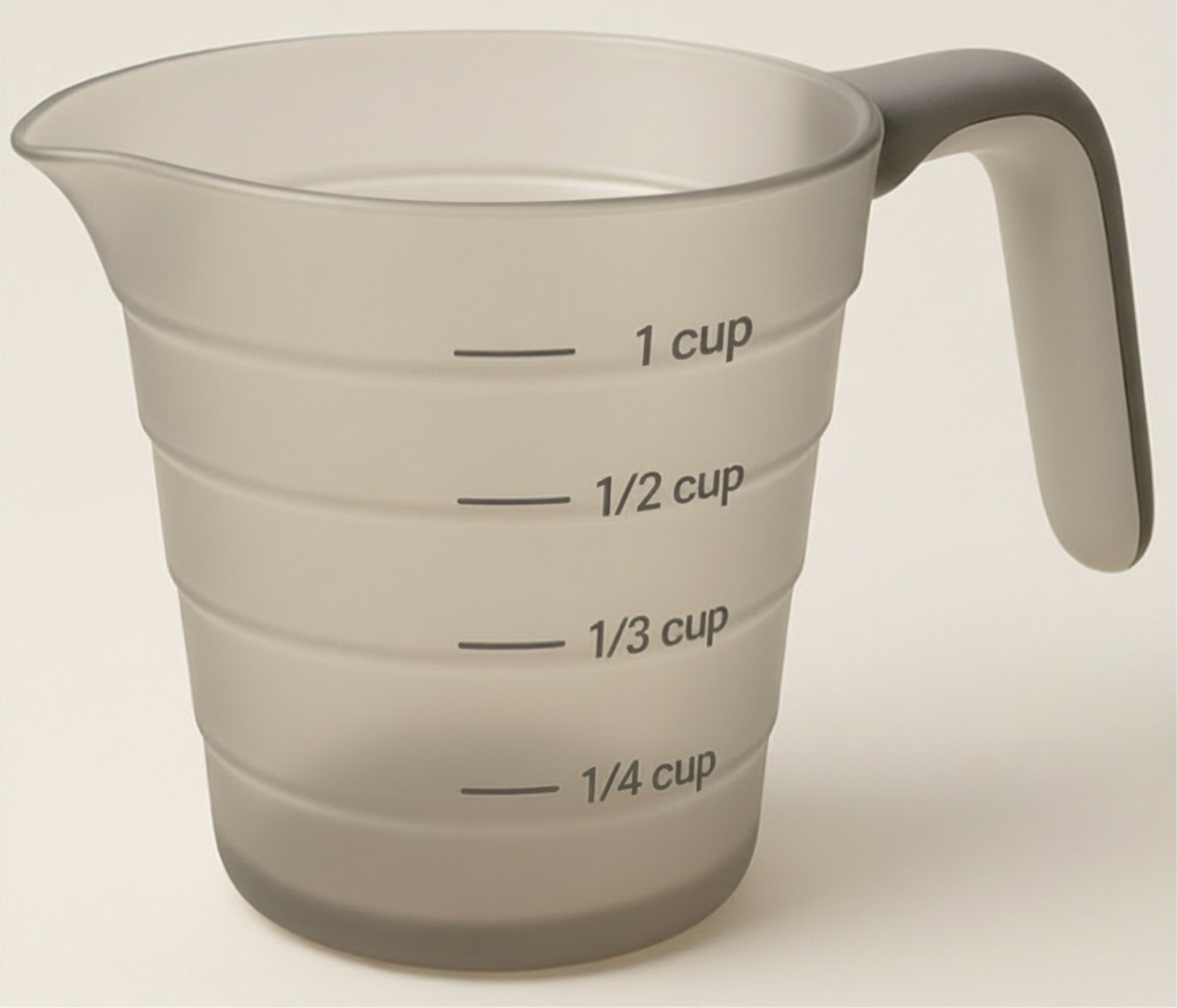
Identifying Everyday Friction in a Common Tool
Despite its simplicity, the traditional measuring cup often fails to meet users’ needs. Through early observation and interviews, we found that users frequently misread measurements, struggle with stability when pouring, and find markings difficult to see. Our goal was to make measuring more intuitive, accessible, and reliable for all users. Many of these frustrations are not a result of user error but of poor product design.
Understanding the User and the Tool
To understand where traditional measuring cups fall short, I began by conducting user interviews and observational studies with home cooks and bakers. Participants were asked to measure both liquid and dry ingredients as they normally would while I observed their body posture, handling, and visual alignment. Across sessions, several patterns emerged: users crouched to eye level to read side markings, overfilled cups that lacked stability when pouring, and often spilled when transferring ingredients. These behaviors revealed that most difficulties were not the result of user error but of poor design decisions that ignored basic ergonomic and visibility needs.
To guide the redesign, I reviewed relevant human-factors standards and existing patents addressing usability and accessibility in measurement tools. The Department of Defense MIL-STD-1472G standard provided anthropometric and grip guidelines that shaped the removable handle’s dimensions and curvature, ensuring a comfortable and secure hold for a wide range of hand sizes. The ISO 24509:2019 Accessible Design standard informed the placement and contrast of the measurement markings, emphasizing legibility from multiple viewing angles and under varied lighting conditions. Together, these standards grounded the design in measurable, user-centered criteria for comfort and visibility.
A review of over twenty patents provided additional context and inspiration. The Measuring Cup with Ramp Indicia (US6263732B1) demonstrated the importance of top-view readability, allowing users to see volumes from above without crouching, which directly influenced my inclusion of subtle annular shelf rings molded into the transparent silicone body. The Reversible Kitchen Devices (US11940312B2) patent offered insight into collapsible volume mechanisms, validating the idea of a flexible measuring system but lacking ergonomic consideration and ease of cleaning. My redesign builds upon these concepts, integrating flexibility, transparency, and stability into a single, cohesive solution.
By combining qualitative user research with standards-based design guidance and patent analysis, this research phase revealed a clear opportunity to reimagine the measuring cup as a more accessible, accurate, and satisfying tool to use.
Translating Insights into Design Opportunities
The research revealed several key areas where traditional measuring cups fail to meet user needs. The first and most consistent issue was visibility. Users had difficulty reading side markings accurately, often needing to crouch or lift the cup to eye level. Poor contrast between the markings and the cup’s material further reduced legibility, especially in low lighting. The second issue involved stability and handling. Many users described the handles as awkward or unbalanced when the cups were full, making it difficult to pour or hold the cup steady with one hand. The third issue related to storage and organization. Nested sets of rigid measuring cups took up significant drawer space, were prone to sticking together when wet, and made it easy to lose individual pieces.
Together, these findings pointed to a clear opportunity: a well-designed measuring cup should not only measure accurately but also fit seamlessly into the rhythm of everyday cooking. The design goals focused on improving readability, balance, and space efficiency, while ensuring comfort and accessibility for users of all abilities. To achieve this, the redesigned measuring cup would need high-contrast, top-view markings for easy visibility, a stable base that allows one-handed pouring, and a collapsible body for compact storage.
Concept Development and Design Exploration
Building on the research insights, the goal of the redesign was to consolidate functionality, improve clarity, and reduce clutter. The concept began with an exploration of mechanisms that could replace traditional nested measuring cups. The most promising direction was a collapsible system that adjusts to standard volumes within a single tool. By replacing multiple fixed cups with one adaptable product, the design aimed to simplify use, streamline storage, and ensure accuracy across ingredient types.
Early sketches explored several directions, including a removable handle that would improve grip and balance for users with limited dexterity. However, as the design evolved, this idea shifted toward a fully removable top section that could serve as both a lid and a grip. This adjustment simplified manufacturing, improved accessibility for cleaning, and gave the product a cleaner, more cohesive form.
The final concept features a transparent silicone body that locks into standard volumes of ¼, ⅓, ½, and 1 cup. Silicone was selected for its flexibility, durability, and ease of cleaning, allowing the cup to invert for washing and fold down for compact storage. Its transparency provides better visibility when measuring liquids, while maintaining a soft, tactile feel that enhances grip and comfort.
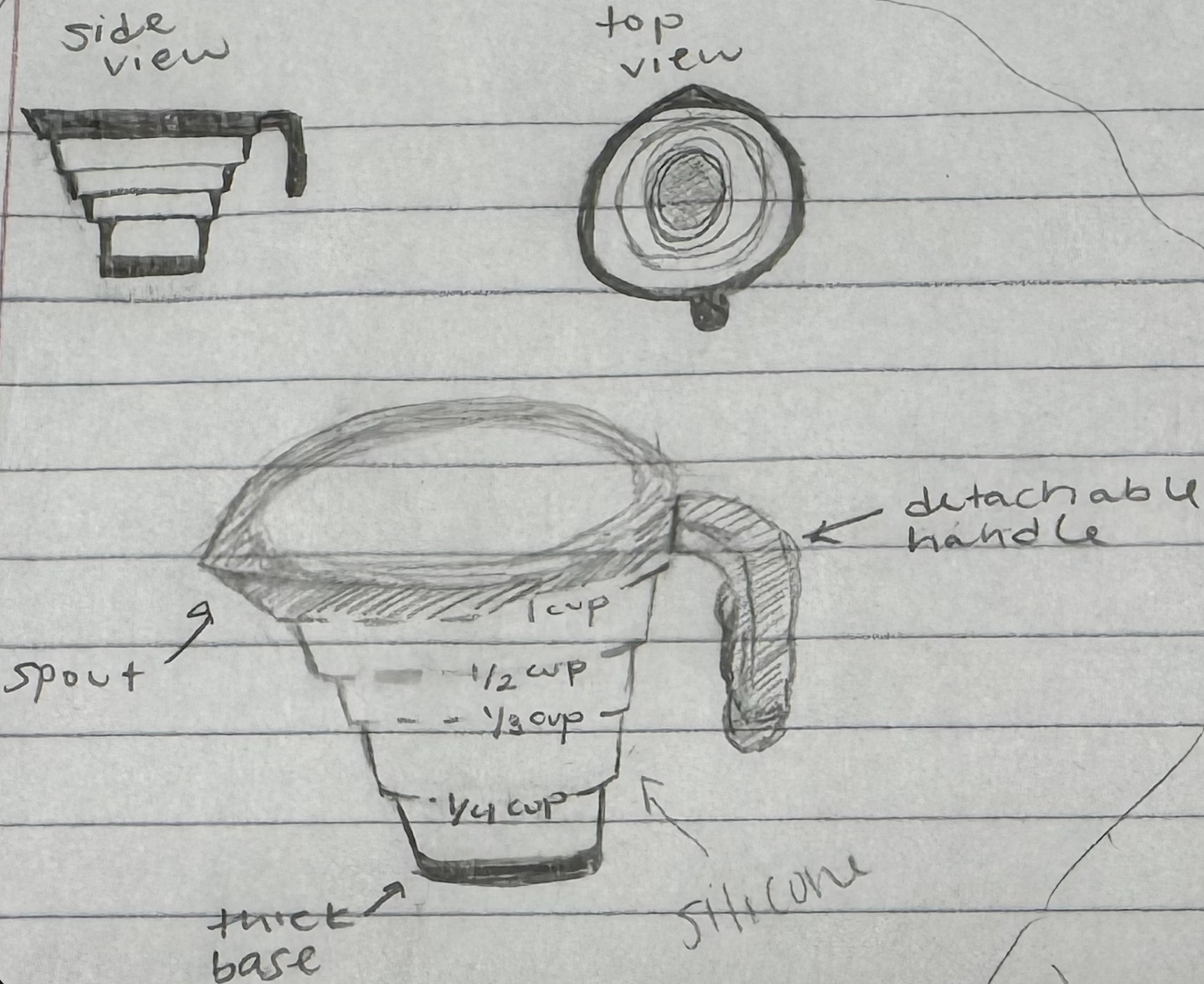

To visualize the product’s functionality, a medium-fidelity 3D model was created in Blender. The model demonstrates how the cup expands and collapses between measurement levels while maintaining stability and balance. This allowed for evaluating form, proportions, and usability before physical prototyping. The resulting design transforms a simple household tool into a more intuitive, space-efficient, and inclusive product that fits seamlessly into everyday cooking.
To improve top-view readability, subtle annular shelf rings were integrated into the interior walls, aligning with engraved numerals on the exterior. This dual system of markings eliminates the need to crouch to eye level, improving accuracy and accessibility.
Learning Through Research and Iteration
This project reinforced the value of grounding design decisions in human-factors research and evidence-based criteria. Translating user frustrations into measurable design objectives helped ensure that each feature addressed a specific need rather than adding unnecessary complexity. It also highlighted the importance of iteration, showing how small changes like replacing a removable handle with a fully removable top can meaningfully impact usability and manufacturability.
Through this process, I gained a deeper appreciation for the role of empathy, testing, and ergonomics in product design. Applying human-factors standards to a simple household object demonstrated that meaningful design improvements do not always come from high-tech innovation but from understanding how people interact with everyday tools.